Painting, decorating and home improvement tips blog
How to Navigate Making Tax Digital (MTD)
Posted by Adrian
August 12th, 2026
Making Tax Digital: What UK Businesses Need to Know
Making Tax Digital (MTD) changes how individuals and businesses manage their UK tax affairs. The move is designed to make tax administration more efficient and reduce errors, while encouraging businesses and taxpayers to keep accurate digital records.
For many business owners, however, MTD can feel like another layer of administration. Thus, understanding what it involves—and preparing early—can make the transition much easier.
What is Making Tax Digital?
Making Tax Digital is a UK government initiative. It requires taxpayers to use digital tools to keep certain tax records and to submit information to HM Revenue & Customs (HMRC).
Rather than relying on paper records or spreadsheets alone, businesses within the MTD rules need to maintain digital records and use compatible software to send their tax information to HMRC.
The aim is straightforward: make it easier for businesses to keep accurate records and for HMRC to receive reliable, up-to-date information.
Who needs to follow Making Tax Digital?
MTD has been introduced in stages.
It first affected VAT-registered businesses, with Making Tax Digital for VAT becoming mandatory for VAT-registered businesses in 2022.
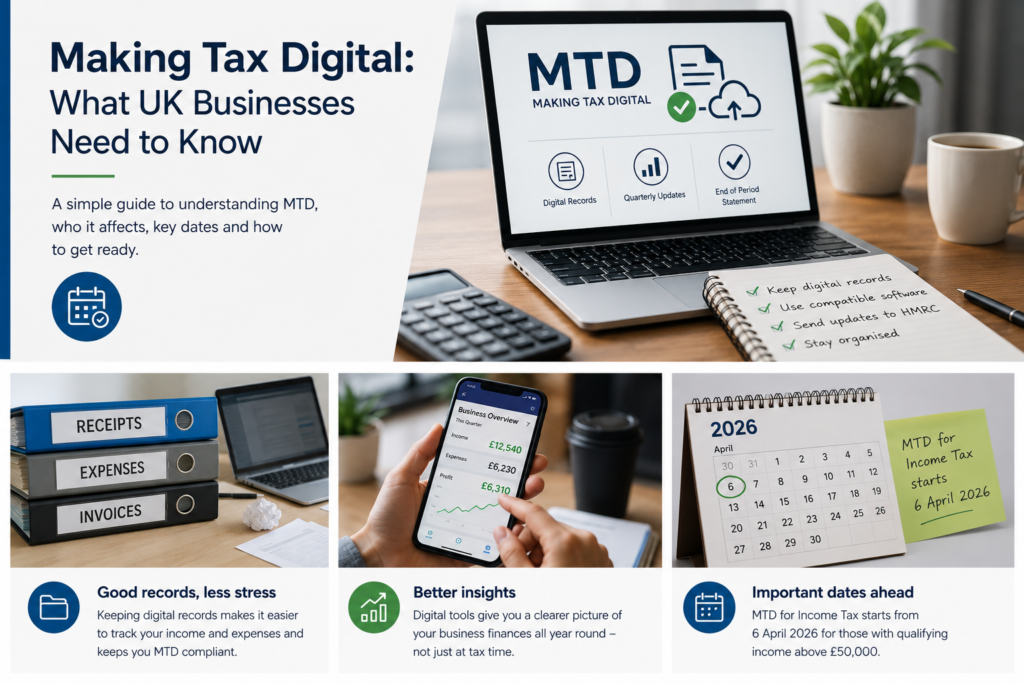
The next major stage is Making Tax Digital for Income Tax. From 6 April 2026, MTD for Income Tax applies to sole traders and landlords with qualifying income above £50,000. The rules are then being extended to those with qualifying income above £30,000 from 6 April 2027, with further changes planned for taxpayers with qualifying income above £20,000.
This means that many sole traders and landlords who have previously managed their tax using traditional methods will need to adapt to digital record keeping and reporting.
What does MTD for Income Tax involve?
For those within MTD for Income Tax, the process is more than simply submitting an annual Self Assessment tax return.
Generally, taxpayers will need to:
- Keep digital records of their income and expenses.
- Use MTD-compatible software.
- Send quarterly updates to HMRC.
- Submit an end-of-period statement.
- Complete a final declaration to confirm their overall tax position.
The quarterly updates are intended to give HMRC information about a taxpayer’s income and expenses throughout the year. They are not the same as four separate tax returns.
Why should businesses prepare now?
The biggest challenge with MTD is unlikely to be the tax itself. For many businesses, the real change will be how financial information is recorded and managed.
If you currently keep receipts in folders, record transactions manually or rely heavily on spreadsheets, moving to a digital bookkeeping system may take some adjustment.
Preparing early gives you time to:
Choose suitable software.
Not every accounting or bookkeeping system will meet MTD requirements. Check that your chosen software is compatible with the relevant MTD rules.
Improve your record keeping.
Good digital records make it easier to identify income, expenses and potential errors before information is submitted to HMRC.
Build better bookkeeping habits.
Updating your records regularly is much easier than trying to reconstruct months of transactions at the last minute.
Get professional advice where needed.
If you are unsure whether MTD applies to you, an accountant or tax adviser can help you understand your responsibilities.
What are the benefits of Making Tax Digital?
Although the transition may require some work, MTD can offer genuine benefits.
Digital bookkeeping can give business owners a clearer picture of their finances. Instead of waiting until the end of the tax year to discover how the business has performed, you can have more up-to-date information throughout the year.
Digital records can also make it easier to:
- Track cash flow.
- Monitor business expenses.
- Find missing transactions.
- Reduce manual data entry.
- Share information with an accountant.
- Keep financial records organised.
For businesses already using accounting software, the move to MTD may be relatively straightforward.
Is MTD something to worry about?
For most businesses, MTD should be viewed as a change in process rather than a completely new tax.
The key is preparation. Leaving everything until a reporting deadline approaches can create unnecessary stress, particularly if your existing bookkeeping system is not ready for digital reporting.
Start by finding out whether the rules apply to you, checking your qualifying income and reviewing how you currently keep your records. If changes are required, introducing them gradually is usually much easier than making a complete switch at the last minute.
Final thoughts
Making Tax Digital represents a significant change in the way many UK taxpayers manage their tax affairs. For sole traders, landlords and businesses affected by the rules, digital record keeping will become an increasingly important part of staying compliant.
The good news is that preparation does not have to be complicated. By choosing suitable software, keeping records up to date and understanding your reporting obligations, you can make the transition much smoother.
If you are unsure whether Making Tax Digital applies to you, it is worth checking the latest HMRC guidance or speaking to a qualified accountant or tax adviser. Getting the right systems in place early can save time, reduce errors and make managing your tax considerably easier.
Tags: HMRC, Making tax digital, Making Tax Digital (MTD), MTD
Posted in News, Resources | No Comments »