Painting, decorating and home improvement tips blog
How to paint a ceiling
Posted by Adrian
April 11th, 2010
How to paint a ceiling
To start gather all the equipment needed
You will need:
- Dustsheets – To cover floor and furniture
- A brush – 1½ or 2 inch
- A roller cage – for the roller sleeve to go onto
- A roller sleeve – for smooth and lightly textured artexed ceilings use a fine or medium pile roller, ideally a 9-inch sleeve, for heavily artexed ceilings a long pile roller sleeve may be required
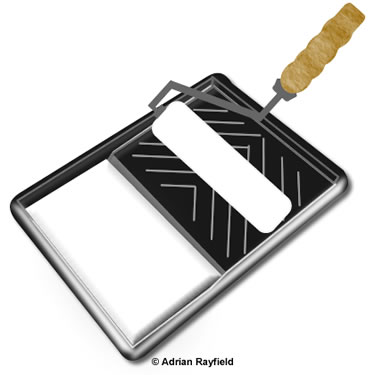
- A roller tray – big enough for a 9-inch roller
- A paint kettle – to tip some paint into for cutting in
- Paint – The paint for the ceiling, normally emulsion (use our paint calculator to determine how much paint you need)
- A step ladder
First move any furniture out of the room and cover any remaining furniture or alternatively cover the floor and furniture with dustsheets. Make sure you can reach the entire ceiling without over reaching, as this is unsafe. Next open your tin of paint and stir well, tip a small amount into the paint kettle, then fill the paint tray.
Now cut in (i.e. paint around the edge) using the brush and kettle, cut in around the ceiling including any light fittings. If you have coving, paint this with the brush also.
Once you have cut in, take your roller and get some paint onto it, roll it on the tray to work the paint into the roller sleeve and get it all around the sleeve.
Now take the roller and roll it over the ceiling, I find it best to work away from a natural light source such as a window
Work in small area’s in front, behind and either side of you, then top the roller up and move to the next area.
When you second coat the ceiling it maybe an idea to work at adjacent angle to avoid any missed area’s, this will also ensure you don’t end up with lines and also will give a nice even coat across the ceiling.
When you second coat the ceiling, cut in as before but this time don’t brush the coving, use a fairly dry roller to go over the coving, this will give a nicer finish. In my opinion anyway!
Tags: Ceiling, Emulsion, Paint, Paint Calculator, Roller
Posted in Decorating Tips | 2 Comments »
How to paint an interior wall
Posted by Adrian
March 8th, 2010
How to paint an interior wall
To start gather all the equipment needed
You will need:
- Dustsheets – To cover floor and furniture
- A brush – 1½ or 2 inch
- A roller cage – for the roller sleeve to go onto
- A roller sleeve – for smooth walls use a fine or medium pile roller, ideally a 9-inch sleeve
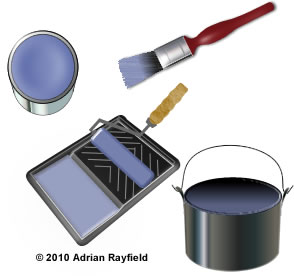
- A roller tray – big enough for a 9-inch roller
- A paint kettle – to tip some paint into for cutting in
- Paint – The paint for the walls, normally emulsion (use our paint calculator to determine how much paint you need)
First cover the floor and furniture with dustsheets. Next open your tin of paint and stir well, tip a small amount into the paint kettle, then fill the paint tray.
Now cut in (i.e paint around the edge) using the brush and kettle, cut in around one wall at a time including any sockets or switches.
Once you have cut in, take your roller and get some paint onto it, roll it on the tray to work the paint into the roller sleeve and get it all around the sleeve.
Now take the roller and roll it over the wall, it is best to roll in a ‘W’ motion, this will ensure you don’t end up with lines and also will give a nice even coat across the wall. When you have covered a wall, go lightly over the wall with an unloaded roller to get rid of any ‘orange peel’ effect.
Simply repeat this operation for each wall you need to paint.
Tags: brush, Emulsion, Paint, Paint Calculator, Paint kettle, Roller
Posted in Decorating Tips | 1 Comment »
VOC 2010
Posted by Adrian
January 1st, 2010

The new VOC legislation
From today (January 1st 2010) there is new legislation regarding the amount of VOC’s (Volatile Organic Compound) in paint. Based on the EU directive 2004/42/EC the amount of VOC’s has to be reduced. From the 1st of January 2010 the production of non-compliant paint is banned and from the 1st of January 2011 the sale of non-compliant products will be forbidden.
So what is the need for this new legislation?
VOC’s are solvents within solvent-based paints such as gloss, undercoat and varnishes. These solvents evaporate into the atmosphere as the paint dries. You can tell how high the VOC’s are in a tin of paint normally by the distinctive smell you get off from them, gloss has a high VOC content where as emulsion has a low VOC content.
If you look at the side of the paint tin it will have a symbol and also some writing about the VOC content in the tin.
The solvents or VOC’s contribute to environmental air pollution and in turn damage the ozone layer.
Many VOC 2010 compliant paints have been on the market for a while now, such as emulsions but for paints such as undercoat and gloss that have higher VOCs these will now be clearly marked as being VOC 2010 compliant.
So does having lower VOC’s affect the paint?
For most DIY painters and decorators there will not be any noticeable changes but for the professional painter and decorator who uses paint all the time, some changes will be noticed. These include:
- Longer drying times
- Yellowing quicker
- Higher sheen level
- Separation in the paint can
So can I still use non-compliant paint?
If you are an applier rather than a manufacturer or supplier you can still use non-compliant paints.
Manufactures cannot make non-compliant paints from today and suppliers have until next year (01.01.2011) to stop stocking and selling non-compliant paints.
For more information, search for VOC 2010.
Tags: Emulsion, Solvent-based paint, VOC 2010, water-based paints
Posted in News | No Comments »