Painting, decorating and home improvement tips blog
Colour trends for 2013
Posted by Adrian
December 18th, 2012
Colour trends for 2013
Dulux Colour Futures™ from AkzoNobel have gathered trends from all sorts of industries such as design, interiors, and fashion as well as social trends, economic trends and have come up with the upcoming trends for the coming year, through their international research they have selected a range of colours they think will be in trend throughout 2013.
Colour palettes and colour moods for 2013
The colour theme is being called ‘Connections’ as this is the
“one dominant influence or idea which inspired us to create the five colour trends”
Quote from ColourFutures™
The theme consists of the following five colour palettes and colour moods:
- Collective Passion
- Switching Off
- The Art Of Understanding
- Home Factory
- Visual Solace

What is to colour for 2013
The colour of the year 2013 is……. 90BB 09/186 (also known as Indigo Blue).
“Like the dreamy ocean landscapes hidden from everyone but deep sea divers, this colour gives us a sense of tranquillity and stability which is very restful. It’s a big and benevolent colour which combines the trustworthy nature and evocative elegance of robust blue.”
Quote from ColourFutures™
You can see more of this years colour schemes here:
Dulux Trade website or here:
http://www.colourfutures.com and download the Colour Futures book(PDF).
Paint Calculator
If you would like to use the colour of the year (90BB 09/186) or any other colour you need to buy and need to work out how much you need to buy, use our FREE Paint Calculator.
Tags: 2013, 90BB 09/186, AkzoNobel, Colour of the year, Dulux, Dulux Colour Futures, ICI, ICI Paints, Indigo Blue, Paint Calculator, Trends
Posted in Decorating Tips, News | No Comments »
How to wallpaper
Posted by Adrian
November 30th, 2012
How to wallpaper
When it comes to wallpapering you must prepare the walls properly first otherwise the paper will not adhere well to the wall, cracks, missing plaster, rawl plugs and filler will show through. Getting the preparation right is very important and around 90% of the job. Once you have removed any old paper, filled and sanded down the walls and sealed any new plasterwork, you are ready to begin.
Choosing your wallpaper
Before you buy your wallpaper you will need to measure the walls of the room, or just one wall if you are just doing a feature wall. We have a wallpaper calculator that is quick and easy to use to work out how many rolls of wallpaper you need.
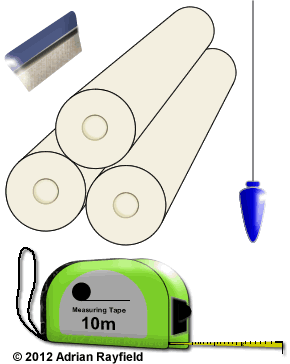
Tools for wallpapering
You will need some tools to wallpaper well and to make you life easier, the following tools are what you will need.
- A paste table
- A clean bucket
- Wallpaper paste
- Rolls of wallpaper
- Paste brush or a roller
- Rolls of wallpaper
- Wallpapering brush
- Pasting brush or a roller and tray for paste
- Clean water
- Sponge or clean cloth
- Tape measure
- Pencil
- Step ladder
- A knife or sharp scissors
- A plumb line
Getting ready to hang the first sheet
Once you have gathered everything together and prepared the walls for wallpapering check your rolls of wallpaper, make sure none are damaged, check to make sure the batch numbers are the same and the shade is the same on all rolls. If they are not the same you can either change them for the same batch or shade codes or work out how many you have of each batch and use these on the same wall, you can get away with different batch numbers or shades codes by using them on an area that doesn’t show or just on a different wall as the light falls differently around the room. Ideally all number should match.
Next mix your paste to the manufactures recommendations, unless your using ready mixed paste of course. Set up your pasting table and take the first roll of wallpaper, unwrap the roll and unroll a length onto the table, familiarise yourself with the pattern and look for the repeat if there is one.
Now take the plumb like, measure out from a corner 2cm less than the width of the sheet of paper, mark the wall then using the plumb line mark a vertical line down the wall.
Hanging the first sheet of wallpaper
Measure from the ceiling to the top of the skirting boards, cut a length of paper off the roll allowing about 5cm at each end to trim the top and bottom of the sheet. Lay the sheet of paper of paper face down on the clean paste table, apply your mixed wallpaper paste onto the back of the sheet from the centre to the edges, make sure the edges are well covered. Concertina fold the sheet and then allow to soak in accordance with the manufactures instructions. Once the paper has soaked for long enough take the top of the sheet and align it with the plumb line you made earlier. Take your wallpapering brush and smooth out the paper and pushing out any air bubbles, start from the centre and work out to the edges.

Once the sheet is smoothed out you will need to trim the top and bottom of the paper with either a sharp knife of a pair of scissors. Now wipe down the paper ensuring you remove all paste from the face of the paper. Wipe down the paste table surface and dry, now paste your next sheet of paper.
Now cut and paste the second sheet of paper and butt the edge up to the first sheet, work the edge down, smooth out as before and wipe the surface, continue doing this until you get to a corner.
Wallpapering around an internal corner
When you come toward a corner, measure from the edge of the last sheet hung to the corner, do this in several places. Take the widest measurement and add 2cm to it then cut a sheet of paper that width. Paste the sheet, once soaked hang as described before but this time wrap around the extra paper around the corner.
Now you can take the other half of the sheet you just cut, or a new sheet (depending on pattern) and measure it’s width. Mark with a plumb line that width from the corner a vertical line. Paste this sheet and then align it with the plumb line and work into the corner allowing it to overlap the paper you have turned the corner with, use a border or vinyl to vinyl adhesive to stick down the edge in the corner.
Wallpapering around a door or window
I recently wrote a post about wallpapering around a door so won’t go to it in detail here, but what I will say is always make sure that you have a straight plumb line as you come out of papering around the door or window as if it isn’t straight you will have problems with the next run of paper!
Papering around switches or sockets

The easiest way is to take switches and sockets off, but DO NOT DO THIS unless you know what you are doing, you should never mess around with electricity! So to leave them on and paper around them, switch off the power, paper over the switch or socket, you an see where the edges of the face plate are, from the centre cut to the corners of the face plate. Now carefully trim the flaps you’ve just made but leaving enough to tuck behind the face plate. Now unscrew the face plate just enough to get the paper behind, carefully ease the plate through the hole in the paper, you will find the plate moves a little so it’s easy to tuck the paper behind, just be careful not to tear the paper.
Screw the face plate back on, wipe the paste of the switch with a damp not wet cloth or sponge, then dry. Now turn the power back on.
You should now have beautiful wallpapered room.
If you found this post of use, please share it via the buttons below, also feel free to comment on this or any other post.
Tags: Cracks, Filler, Paste, Rawl plugs, Tools, Wallpaper, Wallpaper stripping, Wallpapering
Posted in Decorating Tips | 2 Comments »
How to mix wallpaper paste
Posted by Adrian
November 14th, 2012
How to mix wallpaper paste
How many times have you mixed up wallpaper paste to put up that new wallpaper you just bought and end up mixing something that resembles lumpy porridge, jelly or water. The reason for this is you must have mixed it wrong.
So how do you mix wallpaper paste? Firstly you will need to gather the tools you require. You will need :
- A clean bucket
- Something to stir the paste such as a stick
- A sachet of wallpaper paste
Mixing the wallpaper paste
Take your clean bucket and fill it with water, the amount of water will depend on the type of wallpaper you are going to be hanging and how many rolls you are going to hang. It’s always easier to mix an entire sachet rather than trying to mix half as it’s not easy to get the ratio right, unless like me, you have mixed up gallons of the stuff!
Here is a guide to how much water to use and how many rolls you can expect to do with one standard sachet of paste.
| Paper Type | Cold water in Pints | Cold water in litres (approx) | Number of rolls |
|---|---|---|---|
| Normal paper including woodchip | 14 | 8 | 10-12 |
| Washable and vinyl | 12 | 7 | 7-9 |
| Textured and blown vinyl | 10 | 5.5 | 4-6 |
| Embossed papers (Anaglypta® Original) | 10 | 5.5 | 3-5 |
| Embossed papers (Anaglypta® SupaDurable) |
9 | 5 | 1.5-3.5 |
Take the bucket of water and give it a good stir (not with the wife’s wooded spoon from the kitchen), next cut the top off the sachet of paste an tip it all in, now stir again one way then the other, do a figure of eight, do this for around 20-30 seconds.
Once the paste chips are all dissolved leave to stand for a further 90 seconds then give it a final stir before using.
Once mixed, paste will last for a few days in the bucket so you can come back to it cover it to stop anything dropping into it and come back to finish the job another day.
If you need to know how many rolls of wallpaper to buy, why not use our wallpaper calculator.
Tags: Anaglypta, Decorating, Wallpaper, Wallpaper Calculator, Wallpaper Paste, Wallpapering
Posted in Decorating Tips, Video | 19 Comments »