Painting, decorating and home improvement tips blog
How to deal with water stains
Posted by Adrian
June 1st, 2010
How to deal with stains
Following a recent job I did I thought I would do a post about how to deal with stains, in this case, water stains.
I had a call from a client who had a Velux window that appeared to be leaking and had stained the ceiling of their garden room.
After the roofer came and found the source of the problem, a broken tile, and repaired it I went back and decorated the room for them.
The source of the leak had been fixed and the water had dried out so I could start to decorate.
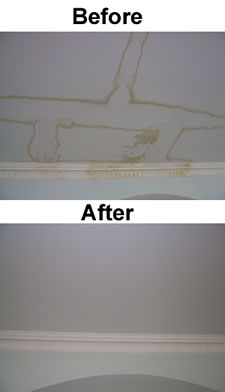
The first thing I did was identifying the stain by drawing around each stain with a pencil so it was easier to see when I used the stain block.
Once I had highlighted all the water stains with a pencil I used Polycell Stain Block to cover the stains, using a brush I painted over the stains, I knew how far to go as I had drawn around the stains. I covered the stains and pencil lines with the stain block, I then prepared the rest of the garden room by filling cracks to the walls while I waited for it to dry which took about two hours.
Once the stain block was dry I could paint the ceiling with white emulsion and the ceiling was as good as new, I then painted the walls to complete the job.
Another job and another satisfied client.
Always ensure the source of the leak is fixed and that you allow time for the water to dry out before decorating.
Some stains may need a second coat of stain block, allow to dry between coats.
Allow the stain block to dry fully before decorating.
Some people use an oil-based paint such as gloss, undercoat or satinwood to block out the stain, I have done this in the past but would only recommend using satinwood or undercoat due to it’s sheen level.
Tags: Polycell, Stain Block, Water Stain
Posted in Decorating Tips | 1 Comment »
How to strip wallpaper
Posted by Adrian
May 2nd, 2010

How to strip wallpaper, and not take off half the wall with it!
At sometime or another wallpaper has to be removed from walls or ceilings, this could be due to many reasons but mostly because it’s faded, old and out-dated.
Knowing how to remove paper without taking off half the plaster with it is important and could save you a load of work and money.
Many people think they will simply go and hire a wallpaper stripper and an hour later all the wallpaper will be off, it’s not as simple as that.
You can save yourself money and not hire a wallpaper stripper just yet, you may not need one, firstly try the old fashioned method.
To start, gather the equipment needed.
You will need:
- Dustsheets – to cover the floor and furniture
- A scraper – to remove wallpaper
- A bucket – Filled with water
- A step ladder – Optional
- A paste brush or a large brush – To wet the wall
Firstly you need to remove the top layer of the wallpaper, with most papers you can remove the top layer as they are peelable, start in a corner by lifting the paper with your scraper and remove the top layer.
By removing the top layer you leave the backing paper behind, don’t be tempted to leave this on and either paint it or paper over it. The backing paper can bubble or lift as you paint or stick the new paper over it.
Tags: Decorating, Filling, Strippiing Wallpaper, Wallpaper, Wallpaper Steamer, Wallpaper stripping
Posted in Decorating Tips | 5 Comments »
How to fill cracks
Posted by Adrian
April 20th, 2010
How to fill crack to walls and ceilings
As many of you know who have done decorating before, preparation is key. Filling holes and cracks, and finishing them well, gives a far better finish. This is a how to guide on filling cracks. These can be on interior or exterior walls or ceilings, the principle is the same.
To start, gather the equipment needed.
You will need:
- Dustsheets – To cover floor and furniture
- A scraper – To apply filler
- Sand/Glass paper – To rub down dried filler
- A dusting brush – This could be a 3 inch brush
- Powder filler – To fill the crack
- PVA sealer – Optional
A quick note before you get started, decorators caulk is not suitable for filling these type of cracks, decorators caulk cannot be rubbed down and is only meant for gaps such as those around skirting boards and door frames.
Firstly you need to open up the crack slightly to enable filler to be applied. Use the edge of the scraper and run it down the crack, your aim is to make a ‘V’ shape by opening both sides of the crack.
Tags: Decorator Caulk, Filler
Posted in Decorating Tips | 1 Comment »